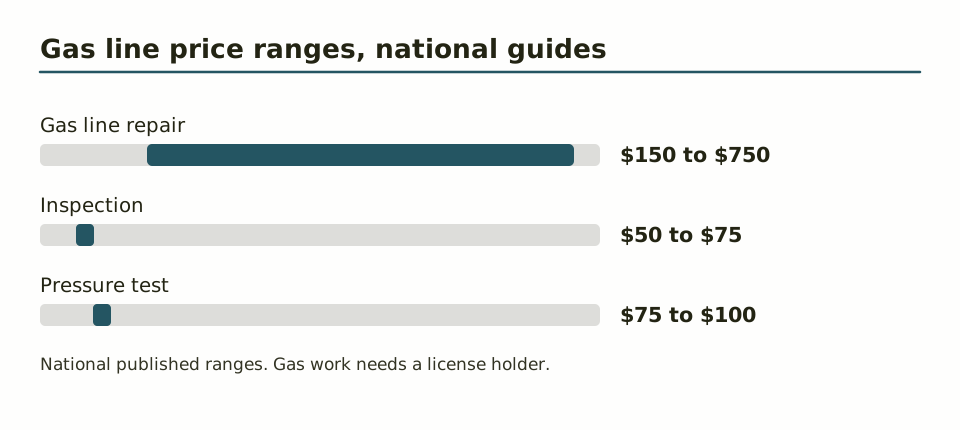
A gas line repair usually costs between $150 and $700, with a national average of about $400, according to a published cost guide. A line that is buried and must be dug up can add $1,000 to $1,500. The plumbing business that visits Stockton quotes the real price after finding the problem.
A gas leak is a safety problem before it is a price problem. If you smell gas, leave first and call 911 and PG&E, as the section below explains. For what the work involves, see the gas lines page, and use this page for the money side.
How much does a gas line repair cost?
A gas line repair costs about $150 to $700 for most jobs. One national guide puts the range at $150 to $700 with a $400 average and a full span of $100 to $2,300. Repair type, pipe length and access decide where you land.
| Item | Typical range | Note |
|---|---|---|
| Gas line repair, typical | $150 to $700 | Average about $400 |
| Leak on a buried line | add $1,000 to $1,500 | Digging and restoring the area |
| Same-day or emergency service | add $200 to $300 | Extra on top of the repair |
| Gas line inspection | $50 to $75 | Visual check |
| Gas line pressure test | $75 to $100 | Checks for pressure loss |
What does a gas line leak repair cost, and what is a safe first step?
Fixing a gas leak on an accessible line is usually within the $150 to $700 repair range. The first step is not a repair: if you smell gas, leave the area right away, avoid anything that could spark such as phones, light switches and vehicles, then call 911 and PG&E at 1-800-743-5000. Do not turn the gas back on yourself.
PG&E says to wait for PG&E or another qualified professional to inspect the system first. That is also the point at which a plumber gets involved: after the emergency is handled and the service is shut off safely, a plumbing business can find the source and quote the repair. The emergency gas line repair page covers urgent situations in more detail.
What pushes the price up or down?
The main drivers are pipe material, repair type, access and timing. Metal pipes cost more than plastic, a buried line costs far more than an exposed one, and after-hours visits add to the bill. A quote should say which of these applies to your line.
- Pipe material. Repair runs about $15 to $35 per linear foot depending on the pipe material, and replacing pipe about $23 to $35 per foot in the same guide.
- Repair type. Sealing, soldering and replacing a section are priced differently.
- Access and digging. Buried lines need excavation and then restoration of the lawn, driveway or patio.
- Labor and call out fee. Labor and any call out fee are usually billed on top, so ask whether the call out fee is waived if you hire that plumber for the repair. See plumber hourly cost for typical rates.
- Emergency timing. Same-day service adds $200 to $300 in the guide.
- Travel distance. Farther trips add to the fee.
Does a gas line repair need a permit or a license?
In California, gas piping work is plumbing work. The Contractors State License Board lists water and gas lines from the meter to the building under the plumbing contractor classification, C-36, and requires a license for work valued at $1,000 or more or for any work that needs a permit. Gas repair is not a place to save money by doing it yourself.
Repairs often do not need a permit, but moving a line or adding or replacing sections may, so ask the plumber and the local building authority. Whichever plumbing business answers your quote request, its license is yours to confirm on the CSLB site. For more on what drives bills like this, the emergency plumber cost page covers after-hours pricing.
What about a gas line repair cost for a car?
A car's fuel line is a different job done at an auto repair shop, not by a plumber. This page covers the natural gas supply line to a home. This site has no sourced price for a vehicle fuel line, so the step is to ask an auto shop for a written estimate.
The word gas also means two very different systems. If your question is about the line to a stove, furnace, dryer or water heater, the ranges above apply. A new gas appliance hookup is priced as installation rather than repair, and the water heater cost page covers one of the most common gas appliance jobs.
How to compare gas line repair quotes
Compare the scope, not just the total. Ask what the plumber found, what will be repaired or replaced, whether a pressure test is included, whether a permit is needed and who handles it. A quote should say where the line runs and whether digging is involved.
Ask each business for the same details so the numbers match. A quote that gives only a total with no description of the leak is hard to compare. See plumber hourly cost for how call out fees and hourly rates stack up.