Most homeowners need a service and repair plumber: someone who comes out for leaks, clogs, fixtures and water heaters. Other types of plumbers focus on new construction, commercial buildings, sewer and drain lines, or gas piping. The right one depends on the job, so describe the problem first and then ask whether the business does that kind of work. The home page shows how quotes work, and the sections below explain each type.
California licenses plumbing work through the Contractors State License Board (CSLB). The plumbing classification, C-36, covers water and gas piping, water heaters, drain and waste lines and many safety devices. Other classifications overlap with it for sewer, pipeline and boiler work. The business that visits you holds its own license, and you can look any contractor up at cslb.ca.gov before you agree to a price.
What are the different types of plumbers?
The most useful split is by the kind of work: service and repair, drain and sewer, water heater, gas, repiping, new construction and commercial. A single small business often covers several of these, but each has its own tools and habits. Service plumbers fix what broke. Construction plumbers rough in pipes before walls close. Specialists spend most of their week on one thing, such as camera inspections.
Here is how the common types line up against the jobs homeowners actually book.
| Type of plumber | What the work looks like | Typical home jobs |
|---|---|---|
| Service and repair | Arrives, finds the fault, fixes or replaces the part | Leaking faucets, toilets, shutoff valves, burst supply lines |
| Drain and sewer | Clears and inspects waste lines with cables, jets and cameras | Repeat clogs, slow main line, sewer smell, root intrusion |
| Water heater | Replaces, repairs and services tank and tankless units | No hot water, leaking tank, anode rod, flushing |
| Gas fitter (plumbing contractor) | Works on gas piping and appliance connections | Gas line repair, appliance hookups, new lines |
| Repipe | Replaces whole sections of supply pipe | Pinhole leaks, old galvanized or failing plastic pipe |
| New construction | Installs pipes during building or remodeling | Additions, new bathrooms, kitchen remodels |
| Commercial | Larger systems, backflow devices, grease traps | Restaurants, offices, rental buildings |
What are the three types of plumbing?
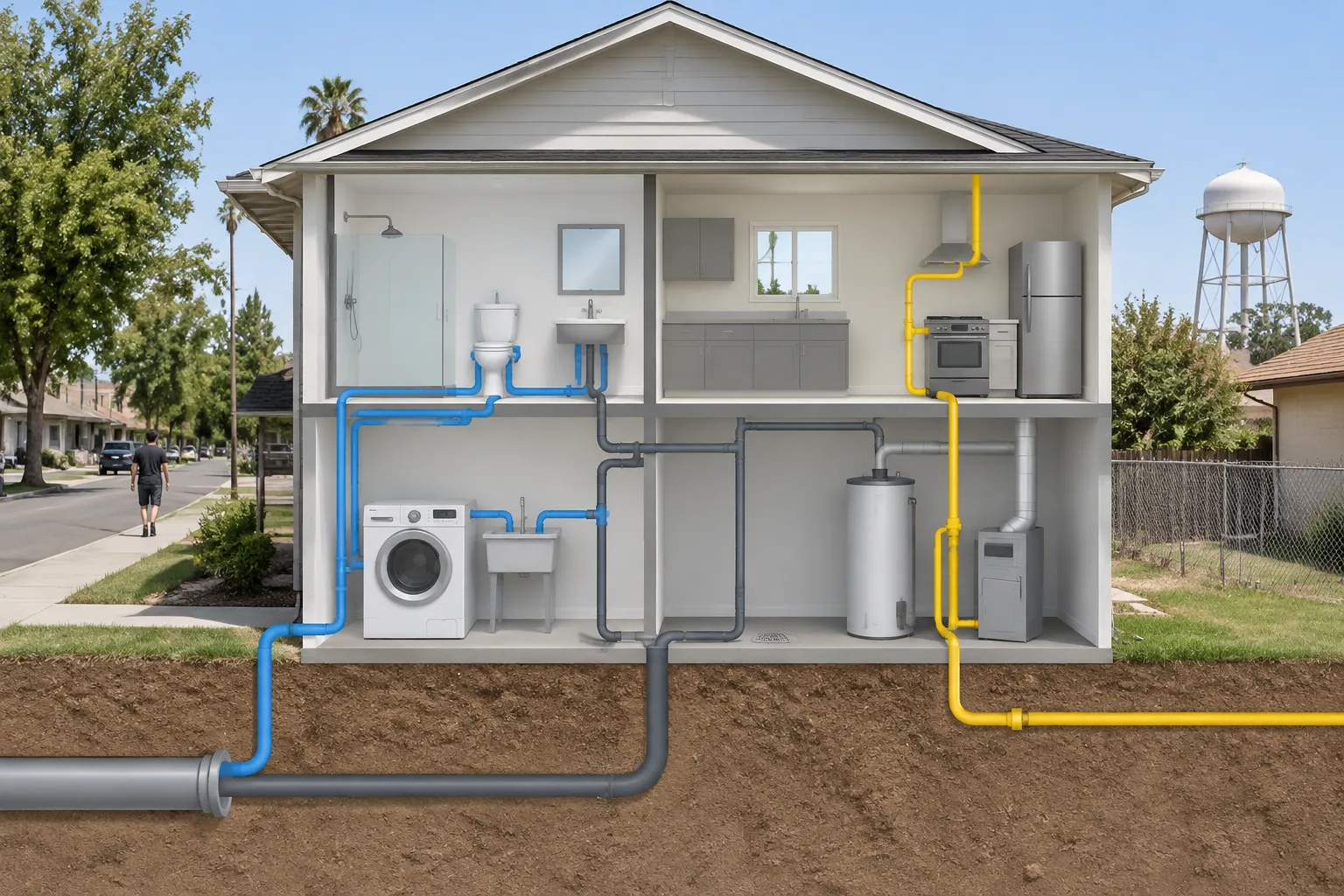
Plumbing is usually described as three connected systems: the water supply that brings clean water in, the drain-waste-vent system that carries wastewater out and lets air in, and the gas piping that feeds appliances. Each system has its own materials, its own failure signs and, in California, its own rules about who may work on it.
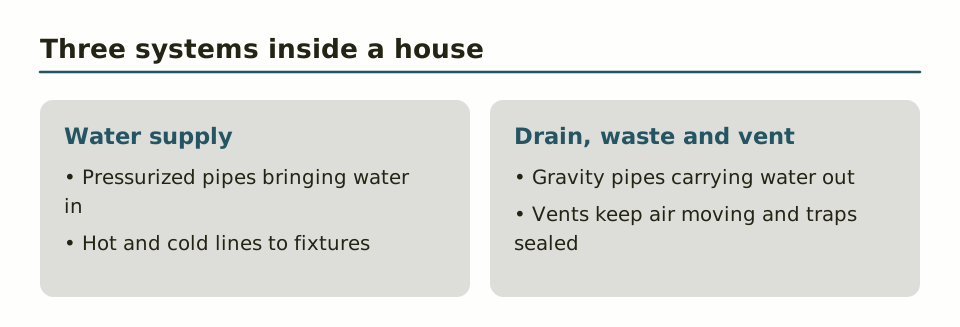
The supply side is pressurized pipe in copper, PEX, CPVC or older galvanized steel. A fault there shows up as low pressure, stains, a wet wall or a bill that jumps. The drain side runs on gravity: slow drains, gurgling and smells point there. Gas piping is the most tightly controlled, and gas work needs a contractor license and is not a weekend project.
You can see how each system maps to pages on this site: burst pipe plumber for supply problems, sewer line repair plumbers for waste lines, and gas line repair by a plumber for gas.
Which type of plumber should you call for your problem?
Match the symptom to the system. Water where it should not be points to a repair plumber. Water that will not leave points to drain work. No hot water points to a water heater plumber. A gas smell is different: leave the building, call 911 from outside, then call your gas utility, and book a plumber only after the area is declared safe.
Some situations are less clear. A wet ceiling could be a supply pipe, a drain or a roof leak, and a wet spot on a slab floor could be a supply line under the concrete. A repair plumber can usually work out which one with moisture readings and a pressure test, then bring in the right equipment.
Questions that help a business route you to the right person:
- What is the symptom, and when did it start?
- Is water still running or has the main valve been closed?
- Which fixture or area is affected?
- How old is the house and its pipes?
- Is the problem only in one room or in the whole house?
For emergencies after hours, the emergency plumber page covers what to do first.
What type of plumbing do old houses have that causes trouble?
Older homes tend to have galvanized steel supply lines, cast iron or clay drain lines, and in some houses built roughly from the late 1970s through the mid 1990s, polybutylene plastic supply pipe. Each ages differently. Galvanized pipe corrodes inside and loses flow. Cast iron cracks and scales. Polybutylene is known for failing at fittings. A plumber can tell which you have by looking.
If your pipes run in an attic or a crawlspace, access matters. Crawlspace pipes are easier to inspect and repair than pipes in a slab, but they are also exposed to damp and pests. Attic pipes face temperature swings. When a house shows several leaks in a short time, ask the plumber whether a repipe makes more sense than repeated patches. Our page on PEX and push-fit fittings explains the materials used in repipes.
Is plummer or plumber the right spelling?
The correct spelling is plumber, with a silent b. "Plummer" is a common misspelling and you may see it in search results, but the trade name comes from the Latin word for lead, plumbum, since lead was once the standard pipe material. If you search under either spelling, the same local businesses appear.
What should you ask before you hire a plumber?
Ask whether the business holds a California contractor license for plumbing and check it at cslb.ca.gov. Ask what the quote includes, whether a permit is needed, how the work is warranted in writing, and what happens if the plumber finds something unexpected. A written price before work starts is normal for planned jobs.
Cost depends on the type of work, access, materials and whether a permit is needed. The plumber cost page explains the price drivers. To compare local businesses, see plumbing companies in Stockton.