A clogged toilet is usually a blockage in the toilet's own trap or the short drain just beyond it, and a plunger clears most of them. Call a plumber when plunging fails after a few tries, the water rises toward the rim, more than one fixture backs up, or you smell sewage. A plumber clears the blockage with a closet auger or a drain machine, which takes less than a few hours, and published prices for toilet unclogging average about $350. To get quotes from local plumbing businesses, use the quote page. The Stockton plumbing home page lists other jobs.
How do you tell if a clogged toilet needs a plumber?
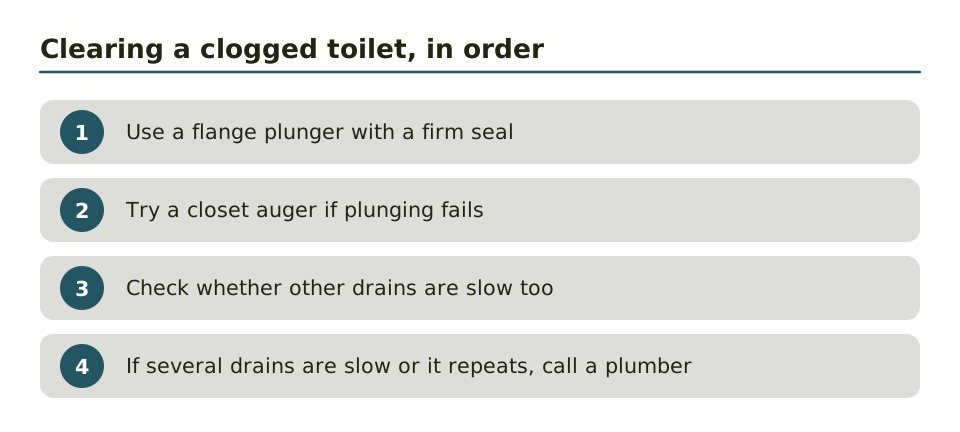
You need a plumber when simple methods fail or the problem is bigger than one toilet. Try a flange plunger, which has a rubber lip that seals the drain, with steady up and down strokes. If the water does not drop after several rounds, or it drops and returns, the clog is deeper. Do not keep flushing: each flush adds water that can overflow.
Signs that point to a plumber:
- The water level rises when you flush a different fixture, or a shower or tub drain gurgles when the toilet is flushed.
- Several toilets and drains back up at once, which suggests a main line clog or a sewer problem.
- A foreign object, such as a toy or wipe, went down the toilet.
- Sewage smell or standing water in a floor drain or tub.
- The toilet clogs repeatedly, even when nothing unusual was flushed.
If water is about to overflow, close the shutoff valve behind the toilet, a small oval valve near the floor, and lift the tank float. For urgent cases, see emergency plumbing. If you have a bad smell without a clog, read plumber for sewer smell.
What do plumbers do to clear a clogged toilet?
A plumber starts with a closet auger, a short, flexible cable made for toilets that can reach the trap without scratching the porcelain. If the clog is further down, they use a drain machine, a longer motorized cable, or a camera to see the blockage. When a hard object is stuck at the base, the plumber may pull the toilet, clear the clog and reset it with a new wax seal.
The steps:
- Ask what was flushed and when the problem started.
- Check whether other fixtures are slow, which shows how far down the clog is.
- Clear the toilet with an auger or machine.
- Test by flushing several times and check for leaks at the base.
- If the clog returns, use a camera to look at the line.
If the plumber suggests more than a basic clear, ask what was found. A repair to the toilet itself is covered on toilet repair.
How much does it cost to unclog a toilet?
A guide, not a quote: Fixr's national figures put professional toilet unclogging at $200 to $700, averaging about $350, with a simple snake or hand-tool job starting near $100 and severe cases reaching $1,000. The plumber quotes the real price after seeing the problem.
| Service | Typical range |
|---|---|
| Hand snake or simple clear | $100 to $250 |
| Pulling and resetting the toilet | $200 to $550 |
| Camera inspection | $250 to $450 |
| Hydro jetting | $250 to $800 |
What moves the price: where the clog is (the toilet, a branch line or the main line), how serious it is, whether the toilet has to be removed, labor rates of roughly $75 to $150 an hour and the time of day. Many plumbers quote a flat fee for a clear. For jetting, see hydro jetting cost.
What is hydro jetting, and is it bad for pipes?
Hydro jetting clears a drain with a high-pressure stream of water from a nozzle on a hose, scouring grease, scale and roots off the pipe walls. It is more thorough than a cable, which only pokes a hole through a clog. It is not automatically bad for pipes, but it is not right for every pipe, so a plumber usually looks at the line with a camera first.
Pipes in poor shape, such as old cracked clay, broken cast iron or pipes with open joints, can be damaged or make a mess. Ask the plumber why jetting is recommended and what the camera showed. Different nozzles do different jobs, and the page on hydro jetting nozzle types explains how. A cable clears a simple toilet clog, and jetting is usually for repeat clogs, grease or root problems.
What about a clogged shower, tub or A/C drain line?
A shower or tub drain usually clogs with hair and soap, and a hand tool or a cleanout of the trap often fixes it. For steps you can try yourself, see how to drain a clogged bathtub and the shower clogged drain guide. A plumber is the answer when it keeps coming back or several drains are slow.
An air conditioner has its own condensate drain line, which can clog with algae and dirt and cause water leaks near the indoor unit. Cleaning it is often an HVAC task, though some plumbing businesses do it, so ask when you request quotes. For companies that focus on drains, see drain cleaning company.
How do you avoid repeat clogs?
Flush only toilet paper and human waste. Wipes sold as flushable, paper towels, cotton products and hygiene items can catch in the trap and lower pipe. Use a strainer in showers and tubs, keep grease out of kitchen drains and clear slow drains early.
Be careful with chemical drain cleaners: they can sit in a blocked drain and splash when a plumber opens it, so tell the plumber if you used one. If clogs repeat across the house, the main line may have roots, a belly or damage, which a plumber can check with a camera. See sewer line repair for what happens then.