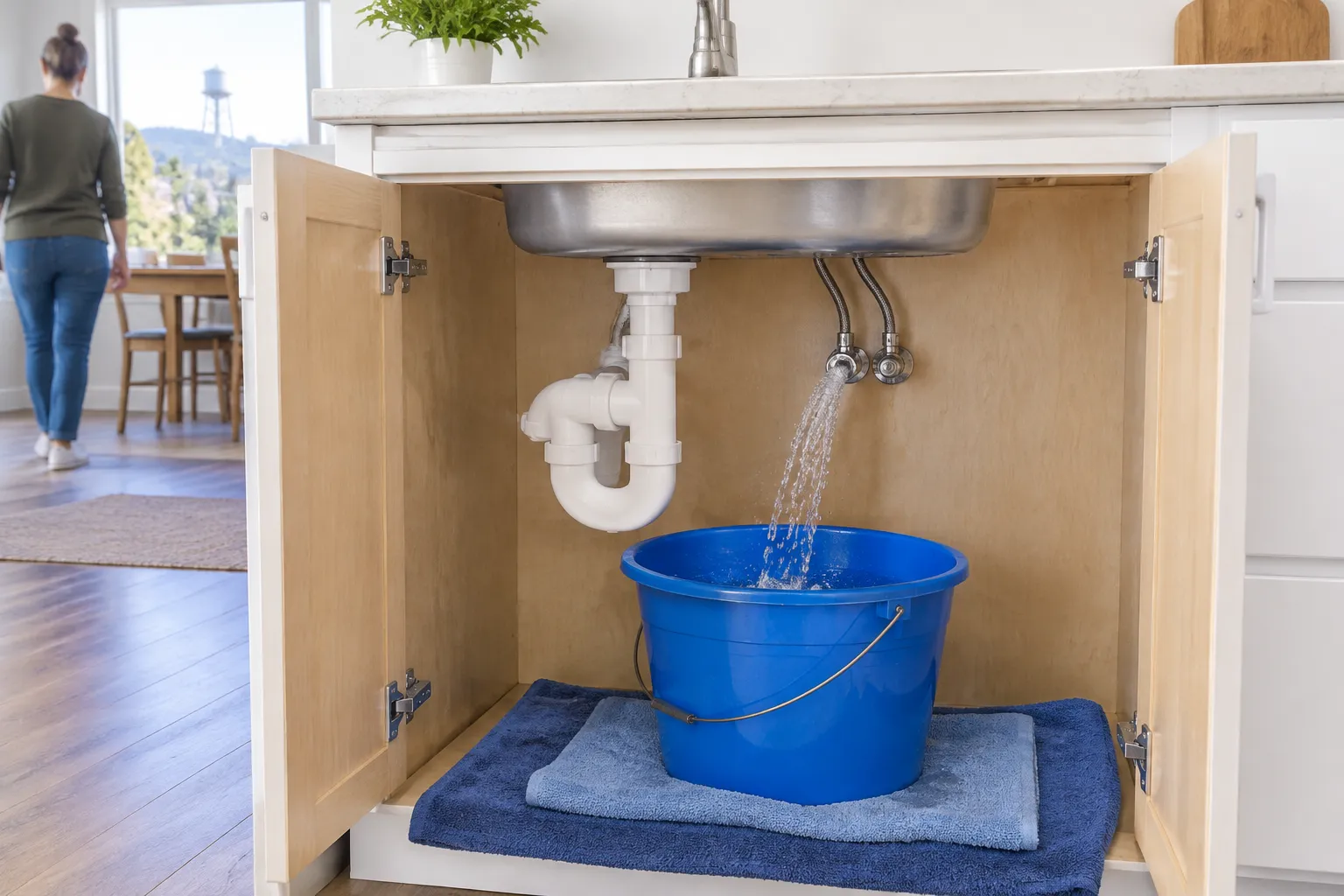
If a pipe has burst under your sink, turn off the water first. Close the two small valves on the pipes under the sink by turning them clockwise. If they will not close or the burst is on the supply side before them, shut off the main water valve for the house. Then limit the damage and call a plumber. This page covers the steps, how to read what failed and what the repair involves. It also sits next to shower repair, since the same shut-off logic applies to any fixture.
What should you do first when a pipe bursts under the sink?
Shut off the water, keep clear of electricity and stop the water from spreading. The shut-off is the fixture's own stop valves, or the main valve if those fail. Do not wait to find the source. Then clear the cabinet, soak up water, and photograph the damage before you move things.
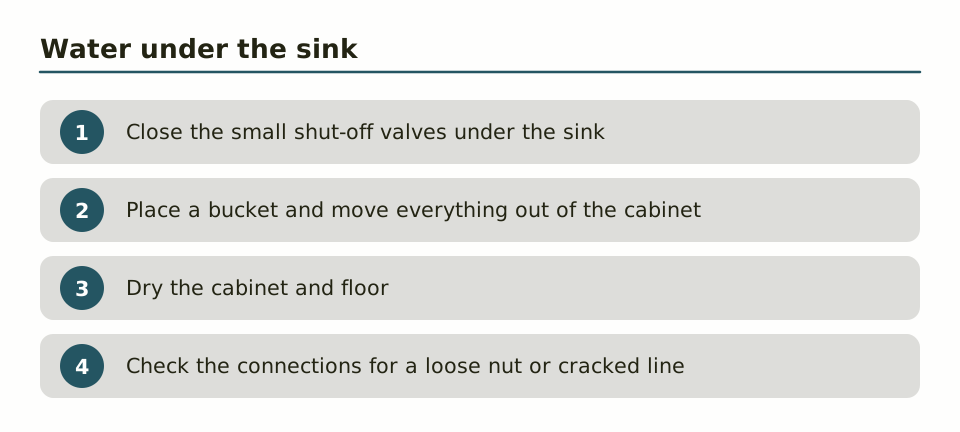
Step by step:
- Close the stop valves under the sink, clockwise for both hot and cold.
- If water keeps coming, close the main valve where the water line enters the house.
- Watch the electrics. Ready.gov's advice is not to touch electrical equipment if it is wet or if you are standing in water. Switch off power only if you can do it safely. Otherwise, stay clear and call for help.
- Open the faucet to let the line drain, once the water is off.
- Empty the cabinet and mop up. Run fans and open windows to dry the space.
- Photograph everything for insurance and keep the burst piece.
- Call a plumber. If water will not stop, ask for an urgent visit, see plumber emergency.
If you rent, tell the landlord or property manager right away.
What actually bursts under a sink?
Usually it is not a rigid pipe that bursts. The usual failures are a flexible supply hose, a compression fitting, a worn stop valve, a cracked drain trap or a pinhole in an old copper or galvanized line. A real burst, where a pipe splits along its length, is less common and is more likely if a line froze or is badly corroded.
| What failed | What you see | Typical fix |
|---|---|---|
| Flexible supply hose | Spray or steady flow from a braided hose | Replace the hose |
| Stop valve | Drip or spray at the valve stem or body | Replace the valve |
| Compression fitting or nut | Drips at a joint that grow over time | Tighten or replace fitting |
| Drain trap or tailpiece | Water only when the sink is used | Replace the trap parts |
| Supply pipe in the wall or floor | Water at the wall behind the cabinet | Repair the pipe, may open the wall |
| Disposal or dishwasher connection | Water when the appliance runs | Reseat or replace the connection |
Knowing which category you are in helps the plumber plan parts and time. If water only shows when you use the sink, the problem is on the drain side, which is not under pressure and is usually less urgent than a supply line.
How does a plumber fix a burst pipe under a sink?
The plumber shuts the water, finds the split or failed part, cuts out the damaged section, replaces it and tests the line under pressure. For hoses and valves, it is a swap. For pipe in a wall or floor, it may involve opening drywall or flooring. The plumber then checks the rest of the lines for corrosion, since the same age usually applies to all of them.
What to expect:
- the plumber confirms the water is off and finds the leak;
- the faulty part is replaced, with new stop valves if the old ones are corroded;
- the water is turned on slowly and the plumber checks every joint;
- the plumber looks at the cabinet floor, walls and ceiling below for hidden water.
Drying and repairing wet cabinets, drywall or flooring usually sits with another trade, such as a water damage restoration company or a carpenter. Ask the plumber what needs drying before anything is closed back up.
How do you tell if a pipe burst under the house?
Signs include a water meter that moves when everything is off, a sudden jump in your water bill, low pressure everywhere, wet or sagging floors, a musty smell, or the sound of running water when nothing is on. Try the meter test: EPA WaterSense says to read your meter, avoid using any water for two hours, then read it again, and if the reading changed, you probably have a leak.
EPA also says a family of four using more than 12,000 gallons a month may have serious leaks, and suggests comparing against a colder month's use.
Other clues for a leak under the floor or in a crawlspace:
- damp soil or standing water under the house;
- warped floors or flooring that feels soft;
- a hissing sound in a quiet room;
- a spot on the lawn or driveway that stays wet.
If you suspect one, shut off the main valve and call a plumber. Do not crawl under the house in standing water near electrical wiring. Read plumber for a water leak for what the plumber checks and how leak detection works.
What affects the price of a burst pipe repair under a sink?
The price depends on which part failed, how reachable it is and how fast you need it. A plumber quotes the real price after seeing the damage. A hose or stop valve swap is a small repair, and a leak inside a wall is a bigger one. See plumbing cost per fixture for how plumbers price fixture work.
Factors:
- The failed part. A hose, a valve and a wall pipe are not the same job.
- Access. Opening a wall or lifting a floor adds work.
- Time of day. After-hours calls cost more, see emergency plumber cost.
- Pipe material and age. Old galvanized or copper lines may need more than a patch.
- Water damage. Drying out and repairs are usually billed separately.
Get the price in writing. California's contractor board says a job over $500 in labor and materials needs a written contract, and the down payment should not exceed 10 percent or $1,000, whichever is less. Check the contractor at cslb.ca.gov.