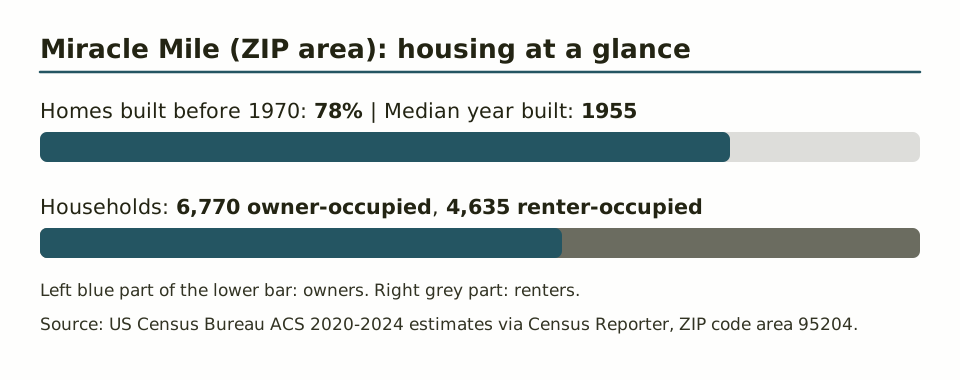
Miracle Mile is mid-century Stockton. In ZIP code area 95204, a wider area that includes the Pacific Avenue shopping and dining strip, the median home was built in 1955 and about 78% of homes date from before 1970. That points to galvanized or early copper supply pipes and old sewer laterals, plus a commercial strip with its own plumbing. This page explains the housing, the strip and the street project, and links back to all areas and the Stockton Plumbing Hub.
What homes are around the Miracle Mile, and what do they need?
Mostly houses from the 1940s and 1950s. Of about 12,340 housing units in ZIP code area 95204, roughly 3,130 date from the 1950s, 2,810 from the 1940s, and 1,870 from before 1940. Another 1,870 came in the 1960s, and about 1,480 in the 1970s. Very few are newer: fewer than 450 units were added between 2000 and 2024.
Trade guides describe clay or cast iron as common for sewer and drain lines of the 1940s and 1950s, and bituminized fiber pipe sometimes called Orangeburg for the 1940s to 1970s. Supply lines of this age are often galvanized steel or early copper. Material and condition vary house to house, so a camera inspection of the sewer and a look at the supply pipes tell you more than the build year. If drains back up often, start with drain cleaning companies and the hydro jetting cost guide. If a camera shows a failed lateral, see sewer line replacement cost.
What is the Miracle Mile, and why does it matter to plumbing?
It is the Pacific Avenue shopping and dining strip from Alpine Avenue to Harding Way, plus a stretch of Harding Way between El Dorado and Lincoln streets. Joe Plecarpo conceived it, modeled on the Miracle Mile on Wilshire Boulevard in Los Angeles, and the district dates from 1922, two years before the University of the Pacific moved to Stockton. The campus sits just north of the strip. Caltrans lists $20 million in state funding (Assembly Bill 179, 2022) to the City of Stockton for pedestrian crossings and public safety improvements here.
A community workgroup met from October 2023 through May 2024 and developed a design study for the city. Caltrans' project page gives no construction dates, so treat any street work as unscheduled until the city announces it. Where sidewalk or street work does happen, it can mean water shutoffs, restricted parking and changes to access, and work in public ground may need a city encroachment permit. Ask a plumber what to expect before a visit.
What plumbing do restaurants and shops on the strip need?
Businesses on the strip have needs a house does not: kitchen drains, floor drains and, for food service, grease handling. Ask the City of Stockton or your plumber which grease rules apply to your premises, and ask the plumber what equipment your kitchen has. Backflow testing is another recurring item for commercial water connections, covered in testing backflow. Rates for commercial work differ from residential, as in the commercial plumber hourly cost guide.
Many strip buildings are older than the surrounding houses, and several uses can share one building and one sewer line. When you ask for quotes, say whether you own the building or lease the space, because that decides who approves the work.
Who owns versus rents in the Miracle Mile area?
Ownership is far higher here than downtown. The Census counts about 6,770 owner households and 4,635 renter households in ZIP code area 95204, or roughly three owners for every two renters. Owners make the repair decision. Renters should report problems in writing and ask who is arranging the plumber.
How does the age of homes here affect costs?
Mid-century homes tend to cost more to repair than new ones because access and materials differ. A plumber may have to open a wall to reach galvanized pipe, or dig a trench to replace a clay lateral. No Miracle Mile price survey exists, so no dollar ranges appear here. See the slab leak repair cost and plumber cost guides, and expect the plumber to quote the real price after seeing the problem.
What permits and rules apply?
The strip and the surrounding streets are in the City of Stockton. The city has an encroachment permit page for work in public streets and sidewalks, so ask whether a sewer lateral job needs one in addition to the permit for plumbing inside the property. A plumbing contractor in California works under CSLB classification C-36, which also covers backflow device service and water heating equipment. The business that visits holds its own license, and cslb.ca.gov shows it.