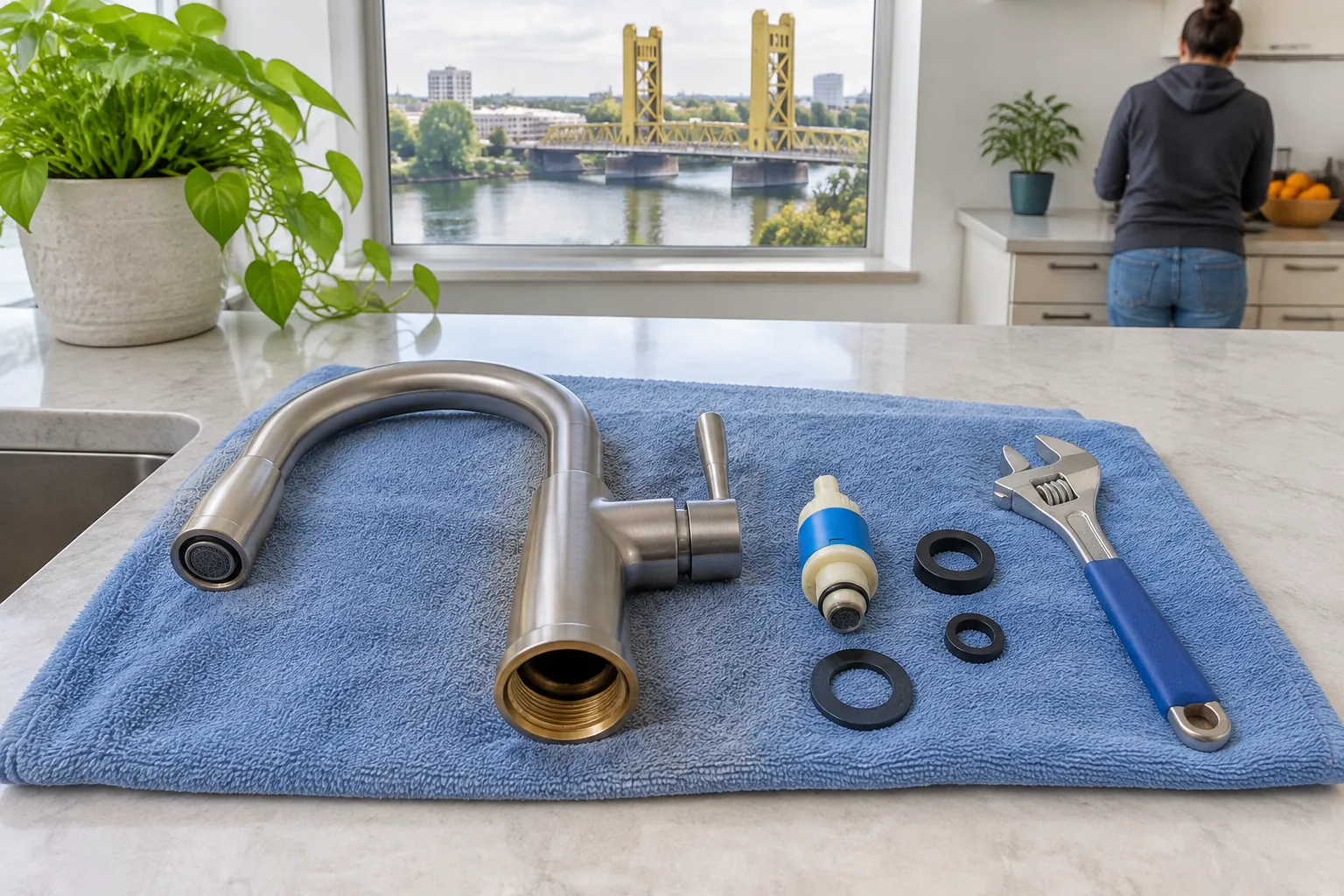
To repair a leaking faucet, turn off the water under the sink, take the handle off, pull out the worn part inside, which is a rubber washer, an O-ring or a cartridge depending on the type, and fit an identical replacement. Put it back together and turn the water on slowly. This job suits most homeowners with a screwdriver and an adjustable wrench. It sits within our guide to faucets, sinks and showers, and below you will find how to identify your faucet, how each repair goes, and how to handle outdoor spigots.
Is it worth repairing a leaking faucet?
Yes, in most cases. A faucet that drips once a second wastes more than 3,000 gallons of water a year, according to the US EPA's WaterSense program, which is the amount used by 180 showers. The parts for a repair are cheap, and the job usually costs far less than a new faucet.
Replace the whole faucet instead if it is badly corroded, if the finish is flaking, if the model is so old that parts are no longer sold, or if you have repaired the same faucet twice. Repair is the right call when the faucet body is sound and only the working parts have worn out.
How do I tell what kind of faucet I have?
Look at the handles. A faucet with two handles is usually a compression type, which uses rubber washers, or a ceramic-disc type that turns a quarter or half turn. A single handle that moves up and down and side to side is a cartridge, ball or ceramic-disc type. Taking the handle off tells you for certain.
- Compression faucet: you tighten to stop the flow. It leaks from the spout, and the fix is a new washer and often the brass seat.
- Cartridge faucet: a single or double handle with a removable cartridge. Leaks from the spout or base usually mean a worn cartridge or O-ring.
- Ball faucet: a single handle over a rounded cap, with a ball valve inside, seats and springs.
- Ceramic-disc faucet: a single handle with a wide cylinder, and discs and seals at the bottom of it.
Check the brand name on the faucet or under the sink. Brands such as Delta and Moen sell replacement cartridge and seat kits by model, which makes parts easy to match. If you cannot read a model number, take the old part to a hardware store.
How do I fix a dripping compression faucet?
Replace the washer and, if needed, the seat. Shut off both supply valves under the sink and open the faucet to drain it. Pry off the decorative cap, remove the handle screw and handle, then unscrew the packing nut with an adjustable wrench and lift out the stem.
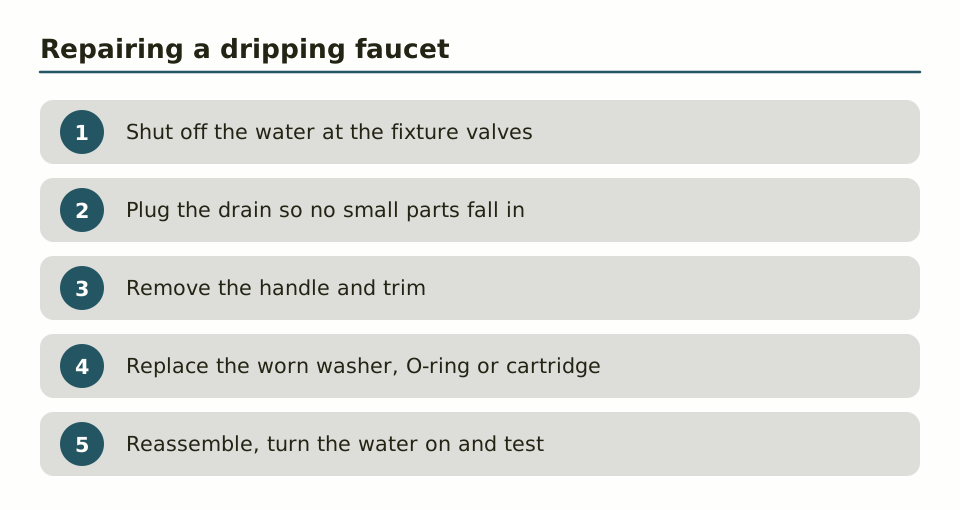
At the bottom of the stem, a rubber washer is held by a small screw. Take it out, match it to the same size, and replace it. Check the brass seat inside the faucet body: if it is pitted, a seat wrench can remove it, or you can resurface it with a seat dresser. Reassemble in reverse order, turn the water on slowly, and check for drips. If the handle leaks when open, replace the O-ring on the stem as well.
How do I fix a leaking cartridge or single-handle faucet?
Replace the cartridge and the O-rings. Turn off the water, remove the handle by loosening the set screw, usually under a cap or at the back, and pull the cartridge straight out. Many cartridges are held by a retaining clip or nut. Note which way it faces before you remove it, because a cartridge fitted backwards gives hot water where you expect cold.
Take the cartridge to the store, buy the exact match, and fit it in the same orientation. Smear a little plumber's grease on the new O-rings. If the faucet leaks at the base rather than the spout, the O-rings on the spout body are the usual cause: slide the spout off, replace them, and push it back on. For a leaking bathtub faucet, the same steps apply, but you may need to shut off the water at the main valve because tubs often have no separate shutoffs.
How do I repair an outdoor faucet or hose bib?
Outdoor spigots usually leak from the handle packing, the stem washer, or from a crack in the body or the pipe behind it. Unhook the hose first. If water drips from behind the handle when it is on, tighten the packing nut a quarter turn. If it still drips from the spout when off, replace the stem washer.
To do that, shut off the water supply to the spigot, which may be a valve inside the house, remove the handle and stem, replace the washer, and reassemble. If water leaks from the wall or the spigot body, the problem may be a failed pipe or a cracked valve inside the wall, which should be checked by a local plumbing business. A hose left attached through a cold night can trap water in the spigot and crack it, so unhook hoses before cold weather. For frozen or broken pipe problems, see how a frozen pipe plumber responds.
When should I call a plumber instead?
Call a local plumbing business if the shutoff valves do not close, if the leak is from the pipe in the wall or under the sink and not from the faucet, if you cannot remove a seized part without force, or if the repair did not stop the leak. A water leak inside a wall can damage drywall and floors quickly.
Those are also the cases where it makes sense to compare a repair with replacement. If you want the price drivers, see plumbing cost per fixture, which explains how labor and parts affect a quote. The plumber quotes the real price after seeing the faucet. You can also read about diagnosing where the drip comes from if you are not sure which part has failed. In California, any job that costs $1,000 or more in labor and materials, or that needs a permit, requires a contractor holding the right license, and you can check any contractor at the CSLB site, cslb.ca.gov. A faucet repair is nowhere near that line.