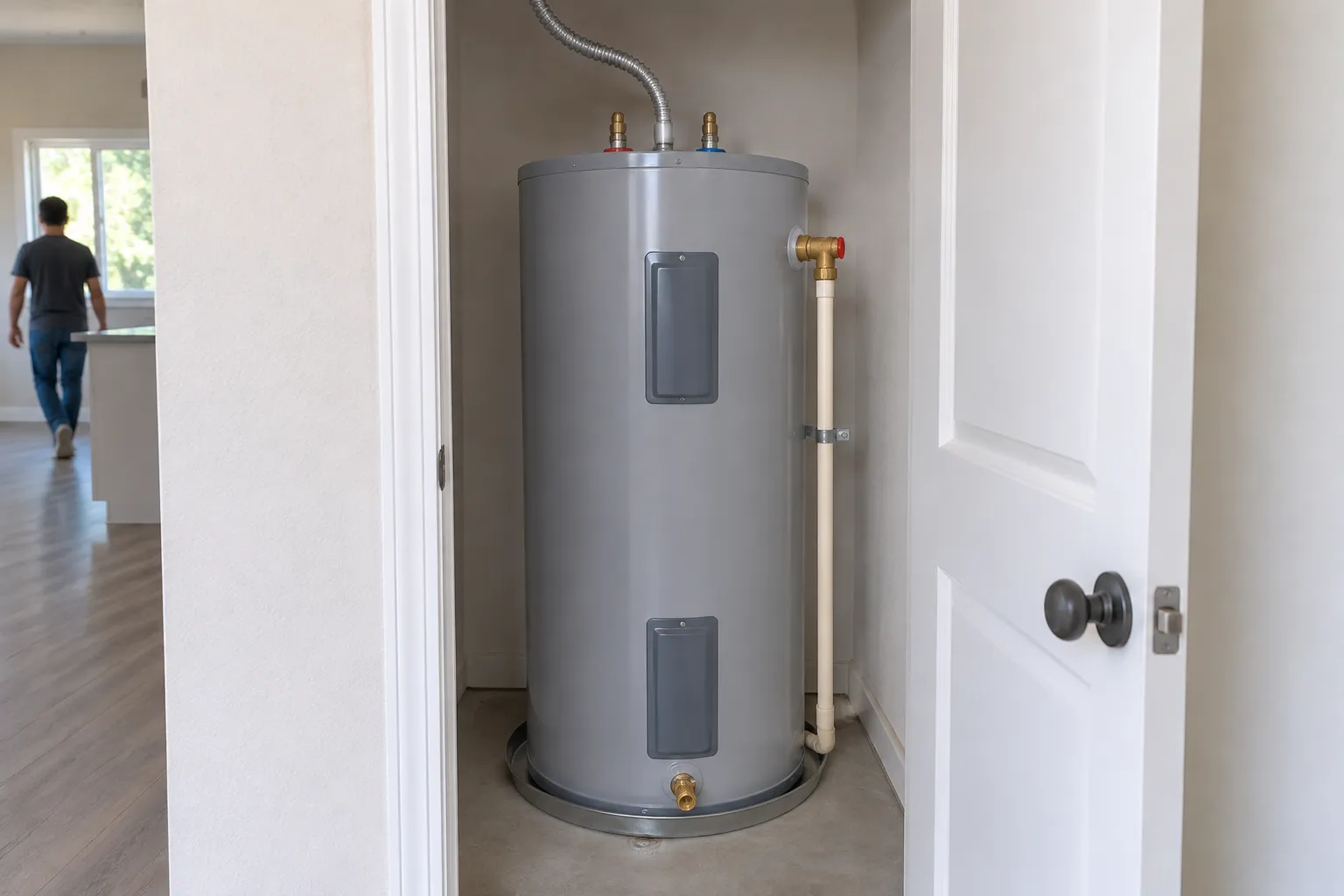
A 40 gallon electric water heater is a storage tank that heats water with electric heating elements inside the tank, controlled by thermostats. It needs a dedicated 240 volt circuit, has no flue, and can sit in places a gas unit cannot. If yours has stopped making hot water, the usual suspects are a tripped breaker, a failed heating element or a thermostat problem. This page explains how the tank works and what you can safely check. The wider picture is in the guide to water heater repair and replacement.
How does a 40 gallon electric water heater work?
Cold water enters the tank through a dip tube and sinks to the bottom. Two heating elements, one near the top and one near the bottom, warm the water, each switched by its own thermostat. A temperature and pressure relief valve protects the tank. Hot water leaves from the top, so you draw the hottest water first.
The upper element handles the first heating of the top of the tank, so you have hot water at the tap quickly. The lower element then heats the rest. On most tanks only one element runs at a time. That is why a failure of one element changes how the tank behaves in a particular way: a dead upper element often means no hot water at all, while a dead lower element often means hot water that runs out fast.
The thermostats live behind small access panels on the side of the tank, under insulation. You should not open them while the power is on. Both the tank and the circuit carry high voltage, and water adds to the risk.
How does it compare with a 40 gallon gas heater?
An electric tank has no burner, no gas line and no flue, so there is no combustion exhaust and fewer parts that can fail. A gas tank usually heats water faster. Which one suits your home often depends on what the house already has: a gas line at the heater, or spare capacity in the electrical panel.
For a side-by-side look at the gas version and its venting needs, read 40 gallon gas water heater. The running-cost and install comparison is in water heater electric vs gas. If you are thinking about a larger tank, electric water heater 50 gallon covers that size, and tank vs tankless water heater covers the bigger change.
Swapping fuel type is a larger job than replacing like with like. Going from gas to electric needs a new circuit and may need panel work, and going from electric to gas needs a gas line and a vent. Both usually require a plumber business and often an electrician.
Why does an electric water heater stop making hot water?
Most often, a tripped breaker, a tripped high-limit reset button on the thermostat, a failed heating element or a failed thermostat. Check the breaker first. If it is fine and the tank is still cold, the cause is inside the tank wiring, and the next step is a visit from a plumbing business.
Work through these in order.
- The breaker. Look at the double breaker for the water heater in your panel. If it is tripped, switch it fully off, then on. If it trips again at once, stop and call someone.
- The reset button. Many tanks have a red high-limit reset behind the upper access panel. Reaching it means opening the panel, so turn the breaker off first. If it trips repeatedly, there is a fault.
- Power outage recovery. After a power cut, most electric heaters start again by themselves. If yours does not, check the breaker, then wait. A full 40 gallon tank takes a while to reheat.
- Water that is warm but not hot. That usually points to the thermostat setting or a failed lower element.
- Water that is too hot. Check the thermostat setting. The US Department of Energy's Building America site, citing the EPA, recommends 120 degrees Fahrenheit to reduce scalding, and notes it saves about 5 percent in energy for every 10 degrees lower.
Replacing an element or a thermostat is a job some owners do with the power off and the tank drained. It involves live wiring, water, and a tank that holds 40 gallons, so if you have any doubt, leave it. The failure patterns, with more detail on noises and leaks, are in water heater leaking hot water.
What should you check before replacing a 40 gallon electric tank?
Check the age and leak history of the tank, the space, the electrical circuit, the bracing, and the thermostat setting. A leak from the body of the tank means replacement, because the steel has failed. A failed element or thermostat is cheaper to fix and often keeps the tank going.
California law, under Health and Safety Code section 19211, requires new and replacement water heaters to be braced, anchored or strapped against falling or sliding in an earthquake. Ask that your quote includes it. Also ask whether the existing circuit and wiring are suitable, whether the shut-off valve on the cold line works, and whether an expansion tank is needed in your setup.
Electrical work and permits matter. California generally requires a contractor license for work that needs a permit, uses additional workers, or costs $1,000 or more in labor and materials, according to the Contractors State License Board. A replacement that includes new wiring will often cross that line. The plumbing business that visits holds its own license, and you can check it at cslb.ca.gov.
For price drivers such as brand, tank size, and access, see water heater cost. The plumber quotes the real price after looking at your home.
How can you make a 40 gallon electric tank last longer?
Flush the tank to clear sediment, keep the thermostat at a sensible setting, and check the relief valve and the anode rod. Sediment sits on the bottom of the tank and can insulate the lower element from the water, which stresses it and makes the tank noisy.
Draining a few quarts from the drain valve at intervals is the usual advice. Instructions for doing it safely are in flush water heater. Shut off the breaker before draining, and never let the elements run while the tank is empty, since they can burn out in minutes.
If you go away, turn the thermostat down or off at the breaker if the heater will not be used for a long period, and turn it back on only when the tank is full of water.