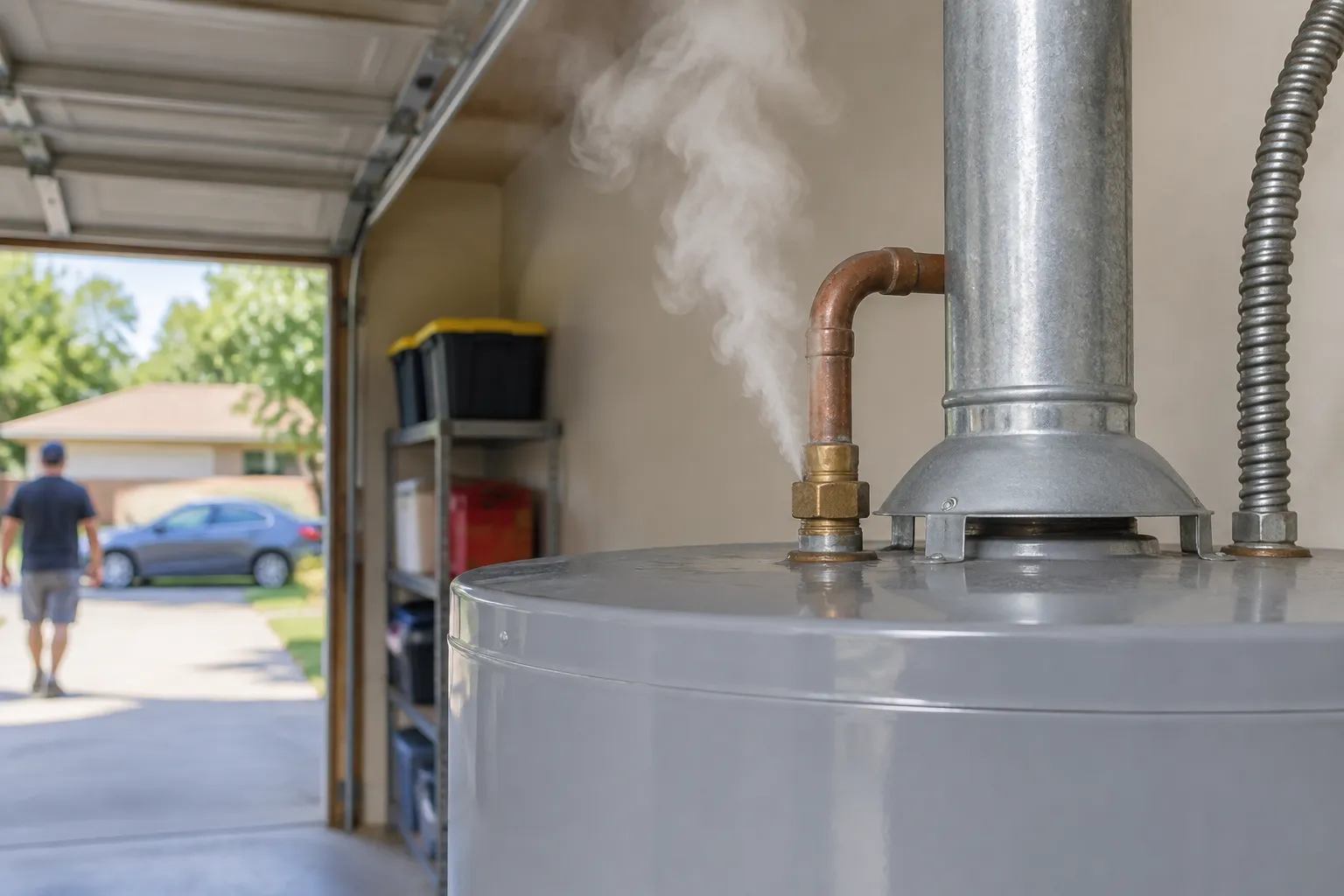
If your water heater is leaking hot water, first find where it comes from. Water from a pipe fitting, the drain valve or the relief valve is often repairable. Water seeping from the tank body, usually at the base or through the jacket, means the steel has failed and the tank needs replacing. Either way, turn off the power or gas, close the cold water supply valve on top, and keep clear of the puddle. This page explains the common causes, what the noises mean, and what to check when the heater stops heating. For how leaks and wear connect to the anode rod, see water heater leaking and failing.
Where is the water coming from?
Dry the tank and floor, then look for the first wet spot. Water at the top, near the pipes, is often a loose or corroded fitting. A steady drip or discharge from the relief valve or its pipe is a pressure or temperature issue. Water from the base or under the jacket often means the tank has rusted through.
| Where the water appears | Likely cause | Fixable or replace |
|---|---|---|
| Top, at the inlet or outlet pipes | Loose or corroded fitting | Often repairable |
| Relief valve or the pipe beside it | Pressure, temperature or a worn valve | See below |
| Drain valve at the bottom | Valve not seated, worn washer | Often repairable |
| Around the heating element (electric) | Failed element gasket | Often repairable |
| Base or tank body | Corroded tank | Replace the tank |
| Damp but no drip | Condensation, especially on gas units | Monitor |
Condensation can mislead you. A gas water heater filling with cold water can sweat on the outside for a short time. If the water dries and does not return, it was not a leak.
The relief valve is a safety device. It opens to release pressure or heat. If water keeps coming from it, do not cap or plug it. See water heater pressure valve leaking for why it happens. A sustained leak from a tank body is explained in water heater leaking, and the choice to call a plumber is covered in plumber for water heater leak.
What should you do right away if it leaks?
Cut the power or gas, then stop the water coming in. For an electric heater, switch off its breaker. For a gas heater, turn the gas control to off or close the gas valve at the heater. Close the cold water valve on the top of the tank, and open a hot tap in the house to let pressure out.
If water is spreading, shut off the main water valve to the house. Move items away, mop, and photograph the damage for insurance. Do not stand in water near electric outlets or the panel.
Do not drain the tank in a hurry. Hot water in the tank can scald, so wait for it to cool or run it through a hose to a safe drain with care. If the leak is serious, the guide to emergency water heater repair explains the next steps, and emergency service plumber covers what to ask on the call.
What do rumbling, ticking and loud noises mean?
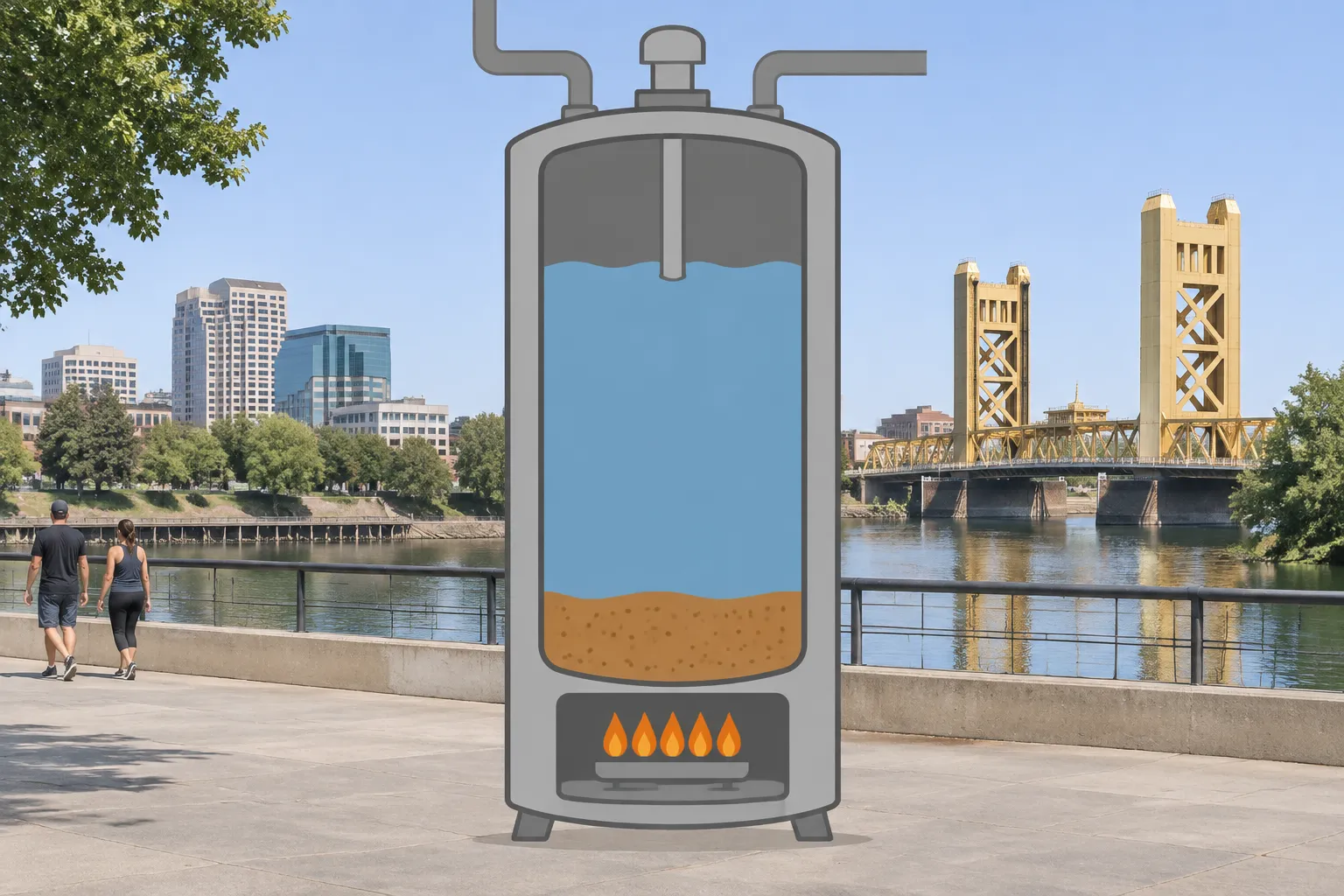
Rumbling or popping often means sediment on the bottom of the tank, where water trapped under it boils and bursts through. Ticking or clicking can be pipes expanding as the water heats, or a fitting that moves. Loud banging may be water hammer. Whistling or hissing may be steam or a leak at a valve.
Noise is often a warning, so do not just ignore it:
- Rumbling, popping, crackling. Sediment buildup, more common where water is hard. Flushing the tank can reduce it. See flush water heater and water heater flush sediment.
- Ticking or clicking. Often thermal expansion of nearby pipes, or a heat trap. It may go away as the tank settles. If it is inside the tank and gets louder, call.
- Loud bang when a tap closes. Water hammer, which is a pipe pressure issue and not the tank itself.
- Hissing with steam or a hot smell. Turn off power or gas and call, since a stuck relief valve or overheating is possible.
- Noise when no hot water is running. Expansion or sediment is common, but a leak at a fitting can also hiss, so check for wet spots.
Water hardness differs across the Stockton area, and no single figure applies to every address, so ask your water supplier for your area if you want to know how much sediment to expect.
Why is a water heater not working, or not heating?
For an electric unit, the causes are a tripped breaker, a failed heating element, a thermostat problem, or a tripped high-limit reset. For gas, they are a pilot light that is out, a failed thermocouple or igniter, a gas supply problem, or a blocked vent. In both, a leak or a cold supply can also be involved.
Checks for an electric heater. Look at the breaker and reset it once. If it trips again, stop. The heating elements and thermostats are inside access panels, and power must be off before anyone opens them. A failed lower element often gives lukewarm water that runs out fast. A failed upper element can give no hot water at all. The thermostat setting matters too: the US Department of Energy's Building America site, citing EPA, recommends 120 degrees Fahrenheit.
Checks for a gas heater. If the pilot light is out, the label on the heater has a relight procedure. Follow it exactly, and never if you smell gas. PG&E says if you cannot relight a pilot light yourself, call PG&E or another qualified professional. If the pilot keeps going out, the cause is often the thermocouple, the gas control valve or a draft problem. If you smell gas at any time, leave the house, call 911, then PG&E at 1-800-743-5000.
After a power outage. Electric heaters usually start heating again on their own once power returns, but a full tank takes time to heat. Check the breaker if there is no heat after a few hours. Gas heaters with an electronic igniter or fan may need a reset, and the manual shows how. Older gas units with a standing pilot may have gone out and need relighting.
Lukewarm or running out fast. The thermostat, a failed element, sediment, or a broken dip tube are all possible, and electric water heater 40 gallon goes into the electric parts in more detail.
When is a leaking water heater past saving?
When water comes from the tank body, the heater is usually past saving, because the inner steel tank has corroded. Age is a clue, but not a rule. A tank that leaks after more than a decade is not unusual, and a fitting that leaks on an older tank may still be worth repairing.
An anode rod protects the tank from corrosion and wears away over time. A plumber can check it, and sometimes replacing it extends life when the tank has not yet leaked. The page on water heater anode rod replacement cost covers what that service involves and what moves its price.
For replacement planning, water heater cost lists what moves the price. California requires new and replacement water heaters to be braced against earthquake movement under Health and Safety Code section 19211, so ask that your quote includes it. A plumber quotes the real price after seeing the heater.
Replacing a heater with gas connections or a new circuit is regulated work. California generally requires a licensed contractor for work that needs a permit, uses additional workers, or costs $1,000 or more in labor and materials. The business that visits holds its own license, and you can check it at cslb.ca.gov.