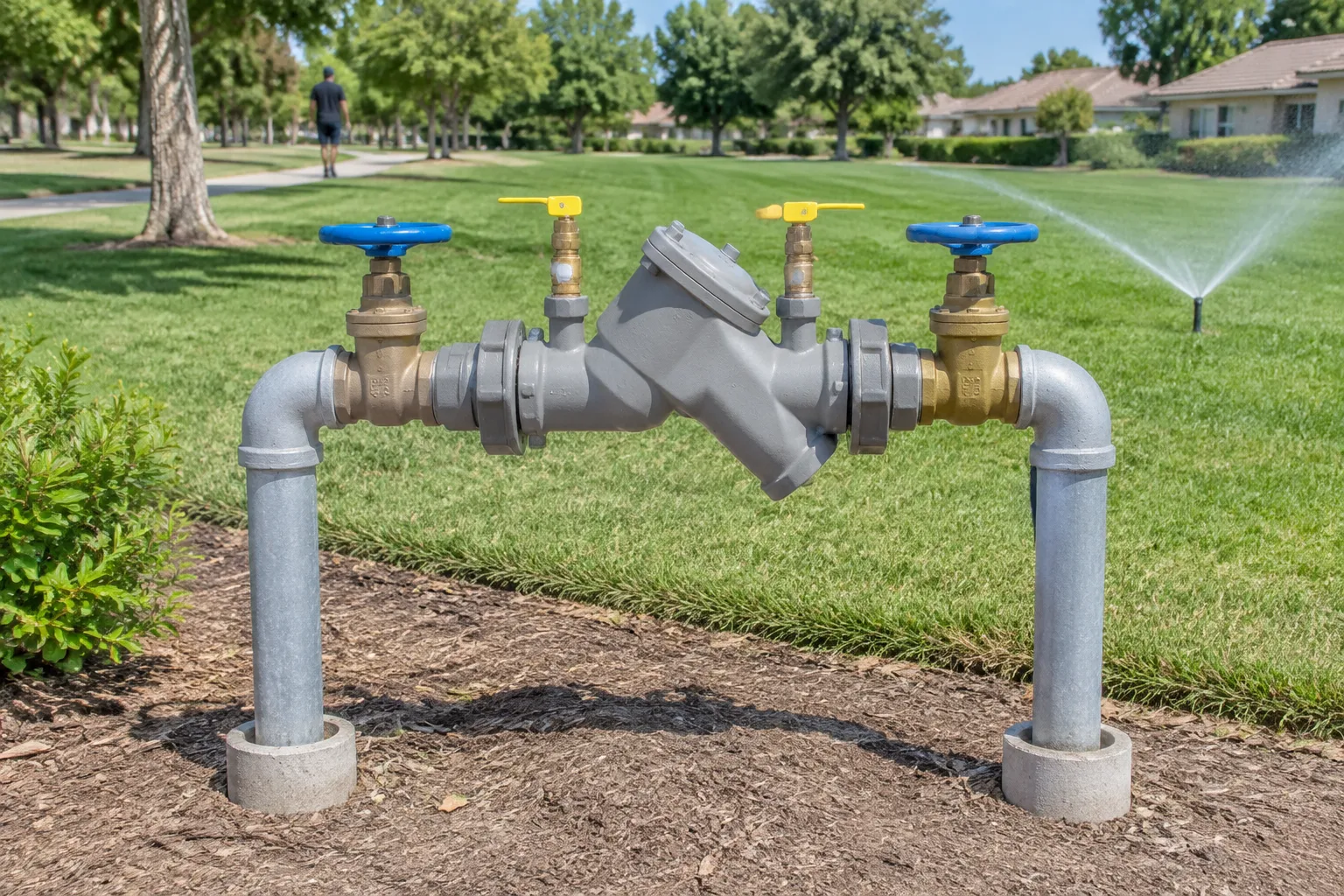
A backflow test checks that a backflow prevention device still stops water from flowing backward into the public supply. It is done by a tester who attaches a gauge to the device, runs a set sequence of checks and records pass or fail. Many California water suppliers require the test every year, and the owner pays. This page explains what the test is, who gets a notice, what happens if a device fails and what moves the price. For other jobs, go to the Stockton plumbing hub.
What is backflow testing?
Backflow testing checks a device that keeps water on your property from flowing backward into the public water line. Water normally flows from the main to your pipes. If pressure drops or rises unexpectedly, the flow can reverse and pull in irrigation water, chemicals or other contamination. The device is a one-way barrier, and the test proves its parts still seal.
Devices are fitted wherever the water could be contaminated: irrigation systems, fire sprinkler lines, pools, boilers and commercial equipment. The tester uses a calibrated gauge kit to check the check valves and relief valve in the assembly, then writes up the result on a report form for your water supplier.
Do you need to test a backflow device in Stockton?
If you have a backflow prevention assembly on your property, you probably need an annual test, but the water supplier sets the schedule and sends the notice. Stockton addresses are served by different suppliers, such as Cal Water's Stockton district or the City of Stockton, so ask the one on your water bill what applies to your address.
Example of how California cities handle this: the City of Ceres says all backflow prevention assemblies are to be tested annually at the owner's expense, sends notices and keeps a list of testers who hold the required certification. It cites the state's Health and Safety Code sections 116800 to 116820 as part of its program. A Stockton supplier's rules are its own, so do not assume another city's dates apply.
Who tends to get a notice:
- homes with a lawn sprinkler or irrigation system that has a backflow device;
- properties with fire sprinklers or a fire line;
- businesses, restaurants, medical and food-handling sites;
- buildings with boilers, cooling towers or processing equipment;
- pools and some spas connected to the supply.
If you are not sure whether you have one, look for a pipe assembly with valves and test cocks, often above ground near the meter or by a lawn sprinkler line, or ask a plumber.
What happens during a backflow test?
The tester shuts off water to the assembly, connects the gauge kit, runs the sequence of readings on each check valve and the relief valve, and records the results. A passing assembly gets a report filed with your supplier. A failing one gets repaired and retested.
Steps in a typical visit:
- The tester locates the assembly and confirms its type and size.
- Water to the assembly is shut off briefly, so expect a short interruption or no irrigation.
- The gauge is connected to the test cocks and each part is checked in turn.
- The tester notes readings and whether the device passed.
- The report is filed with the water supplier, by you or the tester, depending on the supplier.
Plan for water to be off for part of the visit. A lawn sprinkler device can be tested without going into your house. A fire line or commercial device may need to be scheduled around when the building is in use.
Who is allowed to test and repair a backflow device?
The supplier's rules decide who may test. Many suppliers keep a list of testers who hold the required certification, as Ceres does, and accept test reports only from people on it. For repairs, California's contractor board lists maintenance and replacement of backflow preventers and other safety devices under the C-36 Plumbing Contractor classification.
Before booking, check:
- that the tester is on your supplier's list, if it keeps one;
- that the tester's gauge kit is calibrated, as some suppliers require proof;
- the plumbing business's contractor license at cslb.ca.gov if it will also repair or replace parts.
This site is a quote service. The plumbing business that visits holds its own credentials, and you can verify them yourself.
What affects the price of a backflow test?
Price depends on the number and size of devices, how easy they are to reach, and what the supplier requires on the report. A plumber quotes the real price, and many businesses charge by the device. Repairs after a failed test are a separate cost.
What moves it:
- Number of devices. A home sprinkler line is one device, a business may have several.
- Size and type. Large fire-line assemblies take longer than a small irrigation assembly.
- Access. Devices in a vault, below grade, or on a roof are harder to test.
- Failed test. Repair parts, labor and a retest add to the total.
- Paperwork. Some suppliers need the tester to file the report, which can be included or charged for.
For help with the plumbing inspection side, see plumbing inspection cost. If you want a plumbing business to do both backflow testing and general plumbing work for a site, plumbing companies in Stockton explains how to compare them.
What if the device fails the test?
A failed test means a part is worn, a valve is stuck or dirt is holding a check valve open. The usual fix is to clean it or replace the worn parts, such as a seat or a spring, then retest. If the device is damaged or the wrong type, a replacement is needed. Your supplier gives a deadline to fix and retest, so do not leave a failure unanswered.
Ask the tester to explain exactly what failed, and ask whether the repair is covered by the same visit. If the repair cost looks high, you can ask another plumbing business for a quote on the repair, and ask your supplier whether a retest by another tester is accepted.
Backflow problems are different from low pressure, and often a pressure regulator or supply issue is the cause of strange readings. See water pressure regulator and low pressure water for that side.