The most common causes of low water pressure in a house are a main shutoff or meter valve that is not fully open, a failing or misadjusted pressure regulator, clogged aerators and showerheads, mineral buildup in old pipes, and a hidden leak. If only one tap is weak, look at that fixture. If every tap is weak, look at the supply. This page works alongside our guide to the water pressure regulator, the device that most often controls what you feel at the tap.
What is the most common cause of low water pressure in houses?
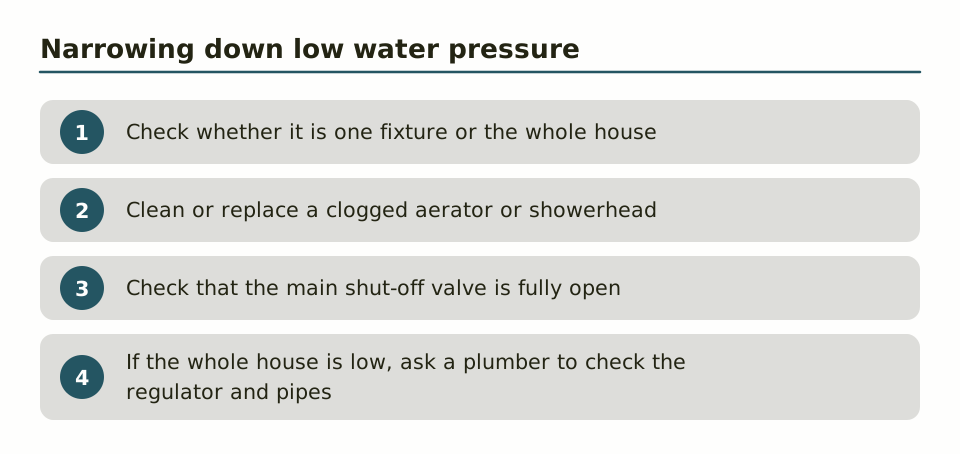
A partly closed valve or a clogged fixture is the usual culprit, and both are cheap to rule out. After that come a worn pressure regulator, mineral buildup inside older pipes, and leaks. The pattern tells you which: one weak tap means a local clog, and a whole house with weak water means the supply side.
Compare hot and cold. If only hot water is weak, look at the water heater valve, the heater's sediment, or the hot-side pipes. If the pressure dropped suddenly, a closed valve or a leak is likely. If it faded over months or years, mineral buildup or corrosion is more likely.
How do I check for low pressure myself?
Start with the main valve and the water meter valve. Make sure the main shutoff where water enters the house is fully open, then check the meter valve, which belongs to the utility, so only look and do not change it. Then clean the aerators and showerheads, and measure the pressure with a gauge.
A pressure gauge screws onto an outdoor hose spigot and costs a few dollars at a hardware store. Close all taps, attach it, and read the number. The City of San Diego's utility notes that California's plumbing code requires a regulator when pressure exceeds 80 psi. A reading far lower than your neighbors report, or one that drops sharply when a tap opens, points to a supply restriction. Write the reading down, since it helps a plumber.
Then do the easy fixes:
- Unscrew a faucet aerator, rinse the screen and soak it in vinegar if crusted.
- Soak a showerhead and clear the nozzles with a brush.
- Open every tap one at a time to see if the problem is house-wide.
- Check the shutoff valves under sinks and toilets are fully open.
Could hard water or water quality be the reason?
Yes, in some homes. Hard water deposits minerals inside pipes, heaters and fixtures, which narrows them over years. Water quality also matters at the tap: sediment can clog aerators and filters, and a whole-house filter that has not been changed slows flow.
Check your water filter first. A clogged cartridge in a whole-house or under-sink filter is a frequent cause of weak flow after it has been in service a long time. Replace it with the one the maker specifies. For Stockton, the supplier depends on your address, and Cal Water publishes an annual water quality report for its Stockton district, so you can read the hardness figure for your area there. Older galvanized steel pipes, found in some old houses, corrode from the inside and lose flow over time, so a house with the original plumbing may need a section replaced. Related articles on water heater flushing cover sediment on the hot side.
Could a leak or a regulator problem be causing it?
Yes. A leak, especially one underground between the meter and the house, can lower pressure while the meter keeps running. A failed regulator can swing pressure too low or too high, which is also hard on appliances and seals. Both are checks a local plumbing business can do.
To test for a leak, turn off every tap and appliance, then read the water meter and wait two hours. If the reading changes, there is a leak. The US EPA uses the same test and notes that the average household's leaks waste more than 9,300 gallons a year. Signs of a regulator problem include a screaming or banging pipe, a gauge that creeps up when no one uses water, and pressure that is wildly different at different times. A regulator is a bell-shaped valve near the main shutoff and a plumber can test and replace it.
Can a plumber help with low water pressure, and when should I call one?
Yes. A local plumbing business can read the pressure, test the regulator, find a leak, and check the pipes. Call when the gauge reads low at the spigot, when all fixtures are weak, when you see signs of a leak, or when you cannot find a closed valve. Who to call first depends on the cause.
If the pressure is low outside the house too, or your neighbors report it, contact your water supplier first, since the issue may be on the utility's side. If pressure is fine at the spigot and low inside, the house plumbing is the place to look. A plumber may also suggest replacing old galvanized pipe, which needs more work than a valve or a regulator.
How much does it cost to fix low water pressure?
The cost depends on the cause: cleaning an aerator costs nothing, a regulator replacement is a small job, and replacing corroded pipe is a larger one. No published price figures from a source worth citing turned up, so the plumber quotes the real price after finding the cause.
What moves a quote is access to the pipe, how many feet need replacing, and whether a wall is opened. For a wider discussion see how much it costs a plumber to fix low water pressure. In California, plumbing work of $1,000 or more in labor and materials needs a contractor with the right state license, and the business that visits holds its own. You can check any contractor at the CSLB website.