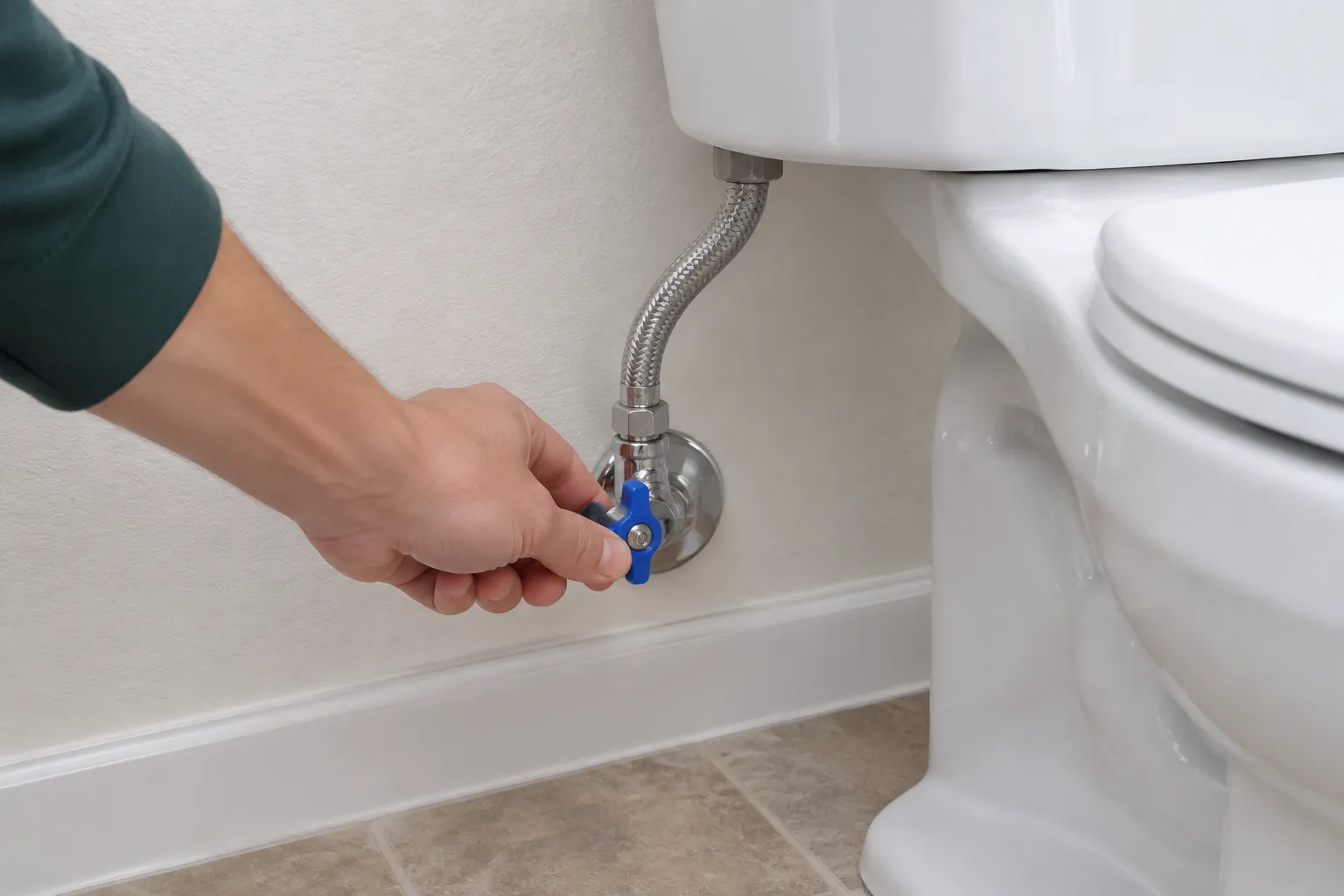
A toilet inlet valve is the valve that lets water into the tank after a flush. The name can mean the fill valve inside the tank, or the small shut-off valve on the wall that feeds the toilet. A fill valve that hisses, never shuts off or refills slowly is usually replaced with a low-cost kit you can fit yourself. A wall valve that leaks or will not turn is often a plumber's job. This page belongs with toilet repair and replacement and shows how to tell which valve you have.
Which valve is the toilet inlet valve?
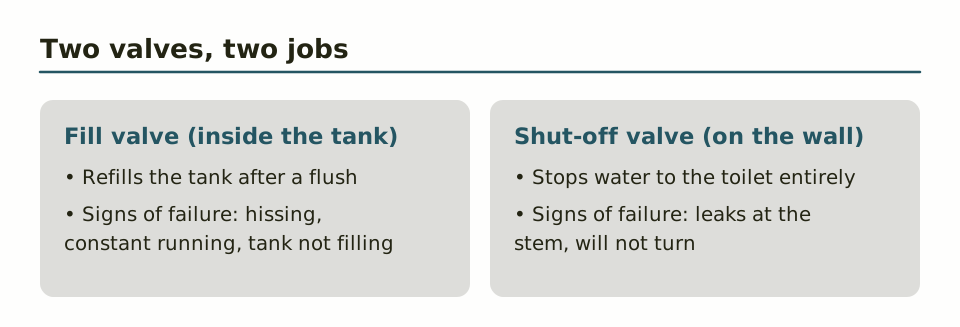
There are two. The fill valve is the tall assembly inside the tank on the left or right, with a float and a hose to the overflow tube. The shut-off valve, also called the angle stop, is on the wall or floor behind the toilet, with a braided or copper supply line running up to the tank. Both bring water in.
If the sound or the leak comes from inside the tank, you are dealing with the fill valve. If water drips from the wall connection, the nut at the bottom of the tank or the supply line, the fault sits in the shut-off valve or the line. Your repair route and your cost are different for each, so identify the right one before you buy parts. A new fill valve will not stop a leaking wall valve, so check first.
How do I know the fill valve is failing?
A failing fill valve gives you one of four signs: the tank keeps running after the flush, a hissing or whistling sound that does not stop, a slow refill, or the water level creeping up to the overflow tube so water trickles down it. The toilet may also refill by itself every few minutes.
Run a quick check before replacing anything. Lift the tank lid and look at the water level. If it sits just under the top of the overflow tube and flows into it, the fill valve is not shutting off, or the level is set too high. The manufacturer's instructions on the packaging explain the level mark. If the level is fine but you hear refilling every few minutes, the flapper at the bottom of the tank is more likely leaking.
You can test the flapper with the dye method the EPA recommends: add a few drops of food coloring to the tank, wait 10 minutes without flushing and look in the bowl. If color shows, the leak is at the flapper, not the inlet valve. Flush straight after so the dye does not stain. More on that fault is on the running toilet page.
How do I replace a toilet inlet (fill) valve?
Shut off the water at the wall valve, flush to empty the tank and sponge out what is left. Disconnect the supply line from the base of the fill valve, undo the locknut under the tank, lift the old valve out, fit the new one at the height shown in its instructions, and reconnect the supply line. Turn the water on slowly and check for leaks.
Step by step:
- Close the shut-off valve by turning it clockwise. If it will not turn, stop here. Forcing a corroded valve can snap it.
- Flush, hold the handle down and sponge the last of the water out.
- Place a towel and a bucket under the connection and unscrew the supply line coupling.
- Remove the locknut that holds the old valve to the tank base and lift the valve out.
- Set the new valve at the correct height, tighten the locknut by hand plus a small turn, and reattach the refill tube to the overflow tube as the instructions show.
- Reconnect the supply line, open the water slowly and watch the connection for several minutes.
- Adjust the float so the water stops at the mark in the instructions, then flush twice and check again.
Do not overtighten plastic nuts, because a cracked tank base means a new toilet. For a longer walkthrough of the same job, see the page on how to repair a toilet fill valve.
What if the wall shut-off valve or supply line is the problem?
A shut-off valve that drips from its stem, will not close or is crusted with mineral deposit is worth replacing, and the supply line should be replaced at the same time. Replacing a wall valve means cutting into the plumbing in the wall or under the floor, so it is a better job for a local plumbing business than for a beginner.
Never keep using a valve that weeps, because slow leaks rot cabinet bases and subfloors out of sight. EPA data shows that household leaks waste more than 9,300 gallons a year on average, and about 9 percent of homes have leaks that waste 50 gallons or more a day. If the supply line itself bursts, close the main water valve and read the page on a burst toilet supply line. If water leaks around the toilet base, that is usually the wax ring or the bolts, not the inlet valve, and the toilet leak page covers it.
When should I call a plumber instead of fixing it myself?
Call a plumbing business if the shut-off valve will not turn, if you see rust or cracked pipe, if the leak persists after you have replaced the fill valve, or if you are not comfortable working with the water off. Also call if the supply valve is part of a bigger repair, such as moving or replacing the toilet.
For small repairs, California generally does not require a contractor license for work under $1,000 in labor and materials, provided no permit is needed and no employees are used, according to the CSLB. A plumbing business that takes on bigger work, or work that needs a permit, must be licensed (CSLB C-36). You can check any contractor at cslb.ca.gov. This site is a quote service, and the plumber who visits holds their own license.
Ask for a price for the repair itself and for any parts, and whether they replace the supply line as part of the visit. Ask which part of the price is parts and which is the visit.