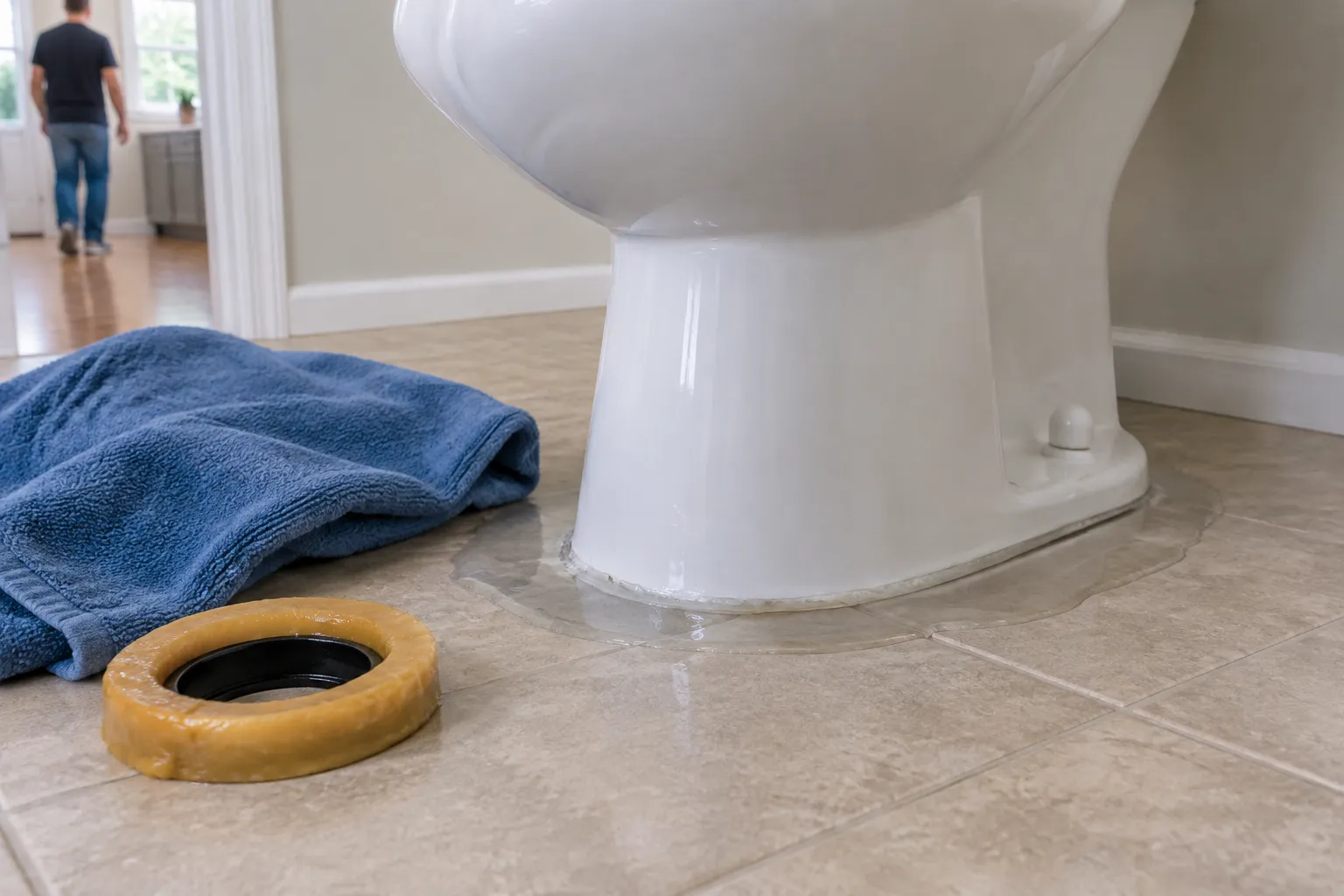
A toilet leak usually comes from the supply line, the shut-off valve, the tank bolts, the tank-to-bowl seal, the wax ring at the base, or a crack in the porcelain. Dry everything with a towel, then watch where the first drop forms. Water at the floor around the base most often means a failed wax ring or loose bolts. Water running inside the bowl with no flush means a tank problem. This page helps you find the source so you can fix it or describe it clearly to a plumbing business. For the full range of toilet jobs, see toilet repair and replacement.
Where is your toilet leaking from?
Find the wettest spot after you wipe the toilet and floor dry. A leak at the base points to the wax ring or floor bolts. A leak under the tank points to tank bolts or the tank-to-bowl gasket. A leak at the wall points to the supply line or shut-off valve. Water inside the bowl points to the flapper or fill valve.
Use dry toilet paper to trace each joint, because paper shows the first wet spot even when the water is only a film.
| Where you see water | Likely cause | Fix usually involves |
|---|---|---|
| Around the base of the toilet | Wax ring or closet bolts | Lifting the toilet and replacing the ring |
| Under the tank, at the bolts | Worn tank bolt washers | New bolts and rubber washers |
| Where the tank meets the bowl | Failed gasket | New gasket or spud washer |
| At the wall or floor near the valve | Supply line, shut-off valve | Replacing the line or the valve |
| Drips from the bottom of the tank | Cracked tank, bad connections | Often tank or toilet replacement |
| Nothing visible, but water bill is up | Silent leak in the tank | Flapper or fill valve |
Do not ignore a slow base leak. Water that seeps under the toilet can soak the subfloor, and wood damage may be there long before it shows. If the floor feels soft near the toilet, or the toilet rocks, that is a sign to get it checked soon.
How do you check for a leak you cannot see?
Use the dye test. The US EPA's WaterSense program says to put a few drops of food coloring in the tank, wait 10 minutes, and look in the bowl for color. If color shows without a flush, water is escaping past the flapper. Flush right afterward so the tank does not stain.
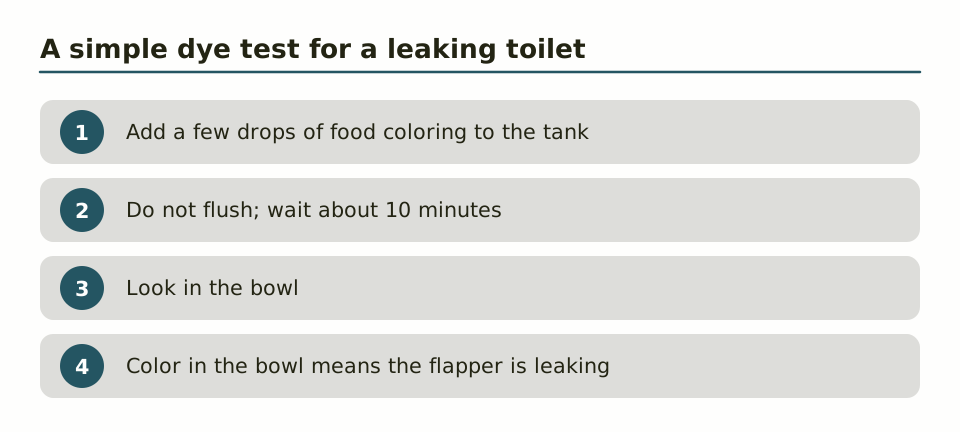
This kind of leak makes no puddle, which is why it often goes unnoticed. EPA says a worn flapper can silently leak thousands of gallons a year, and that the average household's leaks can waste more than 9,300 gallons a year. A rising water bill with no change in use is a good reason to run the test. If the dye test shows a leak, repair a toilet fill valve and how to repair a running toilet cover the steps.
What can you fix yourself?
You can usually tighten loose tank bolts, replace a supply line, replace a flapper, replace a fill valve, and swap tank-to-bowl bolts and washers. Turn off the supply valve behind the toilet first and keep towels ready. Stop if a shut-off valve will not close, or if anything cracks.
Tighten tank bolts gently and alternate sides, because porcelain breaks under force. Replace a supply line with a new braided one of the right length if it looks worn, kinked or corroded, and check both ends for drips when the water is back on.
Tasks that need more care:
- Replacing the wax ring. You must shut off the water, drain the toilet, disconnect the line, unbolt and lift the toilet, scrape off the old ring, fit a new one, set the toilet back straight and bolt it down. A toilet is heavy and the porcelain chips, so ask someone to help.
- Replacing the shut-off valve. This often means turning off the water to the whole house, and old valves can break when moved.
- Anything with a cracked tank or bowl. A crack means the part has failed, and patching it will not hold.
When should you call a plumber business?
Call when the leak is at the base and you do not want to lift the toilet, when the shut-off valve will not close, when the floor is soft, when the porcelain is cracked, or when the leak returns after your repair. A plumber can also check whether a sewer smell or a floor flange problem sits behind the leak.
A leak at the base that is clean water may be a supply problem or condensation. A leak that smells is sewage and needs more urgency, because it can come from the waste line or the flange. If sewage is coming up, see plumber for sewer smell. A supply line that has split can spray water, so shut the water off first, then read burst toilet supply line.
A plumbing business that visits typically replaces the wax ring or the shut-off valve and checks that the toilet sits firm. If the toilet needs replacing, handyman vs plumber toilet install cost explains what changes the price.
California requires a contractor license for work that needs a permit, uses additional workers, or costs $1,000 or more in labor and materials, according to the Contractors State License Board. A small toilet repair is often below that line, but you can still ask a business whether it holds a license and check at cslb.ca.gov. This site is a quote service, and the business that visits holds its own license.
What does a toilet leak repair depend on?
The price depends on the part, whether the toilet must be lifted, the state of the shut-off valve, the floor underneath, and the trip. A bolt or a supply line is usually a short job, and a wax ring takes longer because the toilet has to come up. The plumber quotes the real price after finding the source.
Ask for the parts and labor on separate lines, ask whether the shut-off valve is included if it is old, and ask what happens if damage is found under the toilet. You can describe the leak using the table above, which helps each business quote accurately. There is no price range on this page, because a guess would not help you.
How do you stop a toilet leak from getting worse until help arrives?
Close the supply valve behind the toilet, flush once to empty the tank if the leak is from the tank, and mop up. Put a towel or a pan under the leak and check it every few hours. Do not use the toilet if it is leaking at the base, since each flush forces water under it.
If the supply valve will not turn, shut off the main water to the house at the meter or main valve, and call. If water is coming through a ceiling below the bathroom, shut off the main, move belongings, and call a plumbing business at once. The guide to emergency service plumber tells you what to do first and what to ask.